February 2026 – Clumsy by Design: The Speed of Government
I tuned into a state government Zoom call recently and a staffer noted that they recently had to stop using the WordPerfect software because their computers no longer even allowed them to open the files. This is not hyperbole. If you work as a municipal contractor long enough, you get used to stories like this.
All of us, including consultants (especially consultants?), are accustomed to the internal eyeroll that comes with the ineptitude of government to keep up with the times. But we don’t often stop to think about why government is designed this way, and even what benefits we experience as citizens as a result. Firstly, as a caveat, observations from this post are based on what I’ve seen in state and local government (sometimes called SLED), as opposed to federal. That’s a topic for another day.
As often as we complain about this topic, how often do we stop and think about what would it look like to have a government that is as “nimble” as the private sector? What does that even look like? Would you want your local government to make a swift decision to increase revenue if it meant tripling your water fees overnight? What about deciding to cut down trash collection to every other week to save on transportation and labor costs? Yet, if SLED were operated like the private sector, these types of decisions would be not only possible, but likely.

Clumsy By Design1
"A governing body can plod toward a terrible policy or a good policy, but rarely do you see such entities move swiftly to a wise decision."
I’ve worked with both government and the private sector and have seen a wide spectrum of policy-making processes. The ideal process is sober-minded, discerning, and as swift as possible. A governing body can plod toward a terrible policy or a good policy, but rarely do you see such entities move swiftly to a wise decision. In that sense, the slow and deliberate nature of government decision making has some benefits for all of us.
Another important factor to keep in mind with SLED is that it is primarily mission driven, rather than profit driven. But, these bodies still have the responsibility to provide services and pay its bills, so the mandates of collecting revenue and managing costs are always of critical importance.
I don’t think we need to spend any time thinking about the Cons of “clumsy by design” because we all experience it every day. Instead let’s touch on a few of the Pros that may be less appreciated about government’s slow pace of action:
Prevents government bodies from making hasty and/or rash decisions
The benefit of a slower pace is having time to take a second, third, and fourth look at an issue before coming to a conclusion. This also has the additional advantage of giving citizens the opportunity to bend the ear of Councilmembers2 about unforeseen consequences that may not been have considered.
A nimble government could easily make a decision, realize its unintended consequences, walk it back, institute another policy, and walk that one back. It may sound over the top, but consider certain well-known cases where private companies have followed this same course, such as in 2024 when CrowdStrike (a security firm) rushed a faulty software update to Windows operating systems and caused mass global outages across airlines, hospitals, and banks.
The truth is, if government moved more nimbly it would resemble the movement of a dry leaf in the wind: rapidly back and forth without actually making any forward progress, all the while compromising citizens’ personal property and livelihoods in the process.
Ensures time for the general public to take notice and tune in
Perhaps you live in a town where not everybody can make it at 6pm on the first Tuesday of every month to find out what types of decisions may greatly alter the long-term course of their lives? Yes, I do too. The process of second and third hearings, often baked into city by-laws, prevents democracy from dying (or living) in darkness.
Gridlock can be a feature and not a bug
The closer a government body is to the community that it legislates, the more it will represent the unique contours of that community. I do not know why this is, perhaps some political scientist can weigh in on this matter. If your community is 40% conservative and 60% liberal, it’s very likely that your City Council is quite similar. Councils composed of such members will have a lot of time-consuming cultural and philosophical debates before changing any policies. Whatever side of that fence you are on, at some point at some government level you should be thankful for this.
There is wisdom in the multitude of counselors3
Private businesses, especially small businesses, may be nimble but they could be nimble in a decidedly unwise direction. Local government ensures that there are multiple people with equal influence weighing in on key decisions.
The beauty of City Councils, in particular, is the vastly different experience of people who are elected. This variety of experience allows them to look ahead (and around unanticipated corners) to see what might result from a particular decision. Internal debate among these leaders is likely to attenuate many potentially more extreme reactions to any given situation.
How could it be better?
All that said, this is clearly not an optimized system. So we’ll leave you with some ideas on what can be done to improve the pace and efficiency of how government does business. I am fully aware that government processes are often mandated by some combination of city charters, state constitutions, and institutional inertia. I’m not trying to address the first two, but I will say that often community leaders can let the third influence how they look at the first two to the point that they can excuse themselves out of any form of reasonable changes and enhancements. So, here are a few ideas:
"Often community leaders can let institutional inertia influence how they look at city charters and state constitutions to the point that they can excuse themselves out of any reasonable changes and enhancements."
- Allow Councils to make process decisions that have no major security or financial consequences using technology rather than in-person meetings. Do we really need to use up our public servants’ time to approve a motion to switch from Word Perfect to Microsoft Word?
- Develop strategic plans that Councilors actually believe in – Every decision is hard if you don’t know what direction you’re going. A good Strategic Plan clarifies the merits of about 75% of the opportunities that come across the desks of local officials. Less discussion time equals faster decisions.
- Have more frequent Executive Sessions – Many a time our team has been presenting in a Public Meeting context and thinking “why doesn’t this guy say what he said to me when we met in private?” The stakes are too high for Councilmembers to genuinely hash it out and collaborate when they are behind a dais and have mics within inches of their face. Obviously, the big decisions need to happen in the light of day, but we would benefit from a little bit more back-room chatter.
- Have shorter and more frequent meetings – When Councils meet once a month or once a quarter, the first 40 minutes of the meeting are inevitably “what did we talk about last time?” and “did you do that thing that we talked about?” We need to account for the very human idiosyncrasies of getting distracted and forgetting. Keep the meetings frequent and keep them short.
- Get rid of the laggards – Perhaps the biggest inefficiency of Councils is the inability to make official motions and decisions due to lack of participation from members. This can look like members who don’t show up or members who do not prepare in advance so they can actually provide real input in real time. These are important roles. If someone is too busy or too distracted, then we need more efficient processes to get rid of them and find someone who can keep up. To facilitate this will typically require some form of anticipatory policy built into the by-laws.
Endnotes
______
[1] The title of this post was borrowed and amended from another author who referred to the American investment banking system as “Fragile by Design.” I liked this concept so much I couldn’t help but borrow it, but have to give credit to Charles W. Calomiris and Stephen Haber for the original concept.
[2] To clarify, when we refer to ‘Councils’ in this letter, this could mean any number of permutations, aldermen, councilmembers, board members, etc. pulling strings in local governments.
[3] I’m not the first to say it. See Proverbs 15:22
PC News
Recently Completed Projects
At Home in Fruita: Housing Needs Assessment & Housing Action Plan, City of Fruita, CO
PC conducted a joint Housing Needs Assessment (HNA) and Housing Action Plan (HAP) for the City of Fruita designed to fully comply with all Colorado SB24-174 and DOLA requirements. As a relatively young community with a strong personality, Fruita is poised to grow naturally over the next 20 years. Our projections show the City’s population will grow at a modest 0.7% per year through 2044, adding to current housing demand. To accommodate this growth, PC estimates Fruita will need 390 new housing units over the next 10 years. Our assessment of housing needs in the City culminated in three goals for the HAP: Encourage Housing Diversity, Incentivize Infill & Redevelopment, and Support Affordable & Workforce Housing. These goals include 10 total recommended housing strategies, along with a phased implementation approach for the City to take over the next six years before the next required HNA and HAP updates. In collaboration with City staff and leaders, the implementation approach includes required actions for each strategy, along with potential actors/partners, and Key Performance Indicators to track each strategy.

Okanogan County Community Needs Assessment Update (CNA) Survey Tabulation, Okanogan County Community Action Council (OCCAC), WA
For this project, PC analyzed survey results collected by the OCCAC from a broad cross section of residents and partner agencies across Okanogan County, WA. The results offer valuable insight into community needs and are intended to inform OCCAC’s service planning and strategies for addressing ongoing and emerging challenges.
Ridgway & Ouray County Housing Needs Assessment, Town of Ridgway and Ouray County, CO
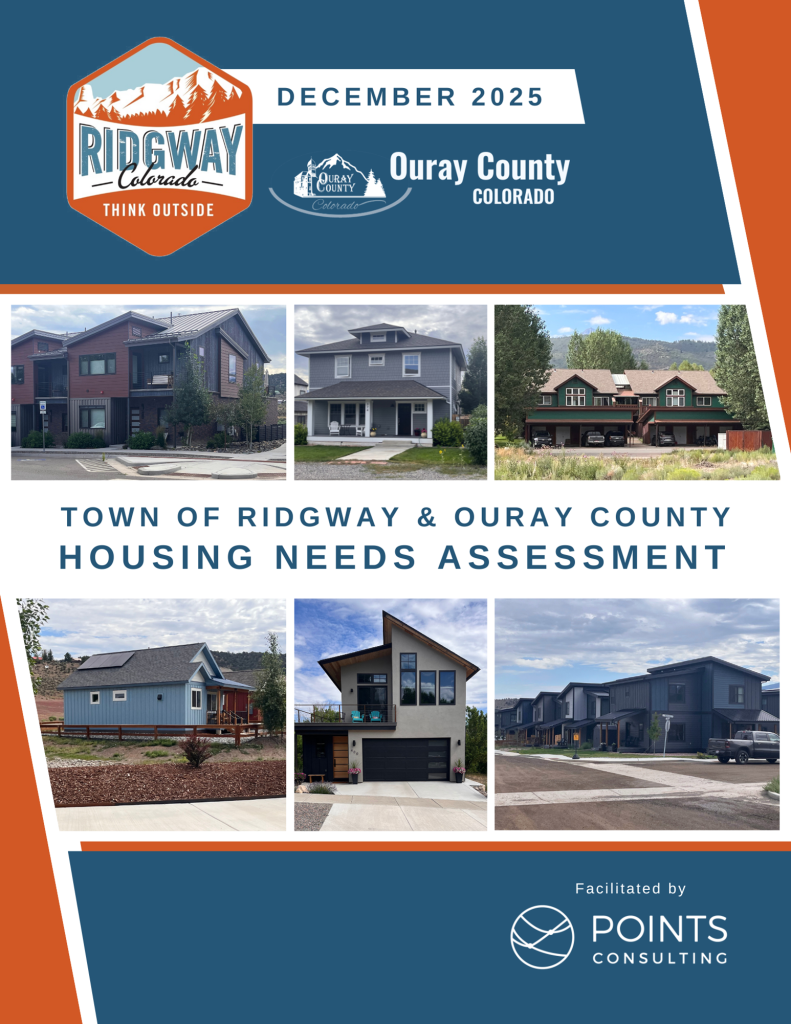
We presented our findings from the Regional Housing Needs Assessment (HNA) for the Town of Ridgway and Ouray County in November 2025. Driven primarily by in-migration, our projections show Ouray County growing by 11% through 2044, amounting to a total need of 375 new housing units in that time period. Residents in the region face high housing costs, with the average home costing nearly nine times the County’s Area Median Income. These trends line up with results from the community survey where 91% of respondents indicated purchasing a home in the County is expensive. Our analysis of affordability (or lack thereof), land capacity, and socioeconomics resulted in a series of recommendations for both the Town and the County, identifying themes of Workforce Assistance and Planning & Zoning Actions to be taken. The HNA is designed to meet all DOLA and SB24-174 requirements as well as address issues faced by Rural Resort Communities. Our housing needs forecast showed an average need of 100% of Area Median Income, providing some evidence for potential Proposition 123 Rural Resort Income Limit petition to be accepted.
Ongoing Projects
NEW! Fort Myers Athletic Center Feasibility Study, Card & Associates Athletic Facilities, Fort Myers (FL)
NEW! Myrtle Beach Benchmarking, Project Grand Strand and Aha! Advisors, Myrtle Beach (SC)
Ketchikan Indian Community Comprehensive Economic Development Strategy (CEDS), Ketchikan Indian Community (AK)
FFA Strategic Plan Environmental Need Scan, National FFA Organization & Schunk Moreland Strategies
City of Cheney Comprehensive Plan, City of Cheney Planning Department (WA) & Nexus Planning Services
Chelan Comprehensive Plan Updates and Land Capacity Analysis, Anchor QEA and City of Chelan (WA)
Douglas County Comprehensive Plan Update, Anchor QEA and Douglas County (WA)
Places We've Been This Month
Fruita, CO
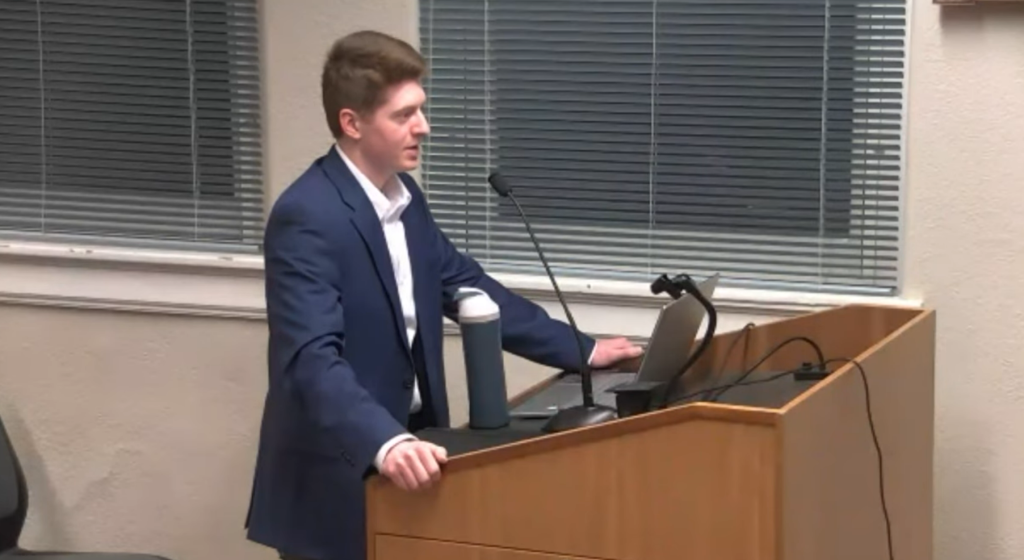
Carson was in Fruita, CO on Jan 20th for a final presentation of our HNA and HAP for the City to address their housing needs. The full presentation was followed by a Q&A from City Council and overall discussion, plus a public hearing so the community had another chance to comment. The report was adopted by the City Council unanimously by resolution at the end.
Interesting Finds
More Newsletters: